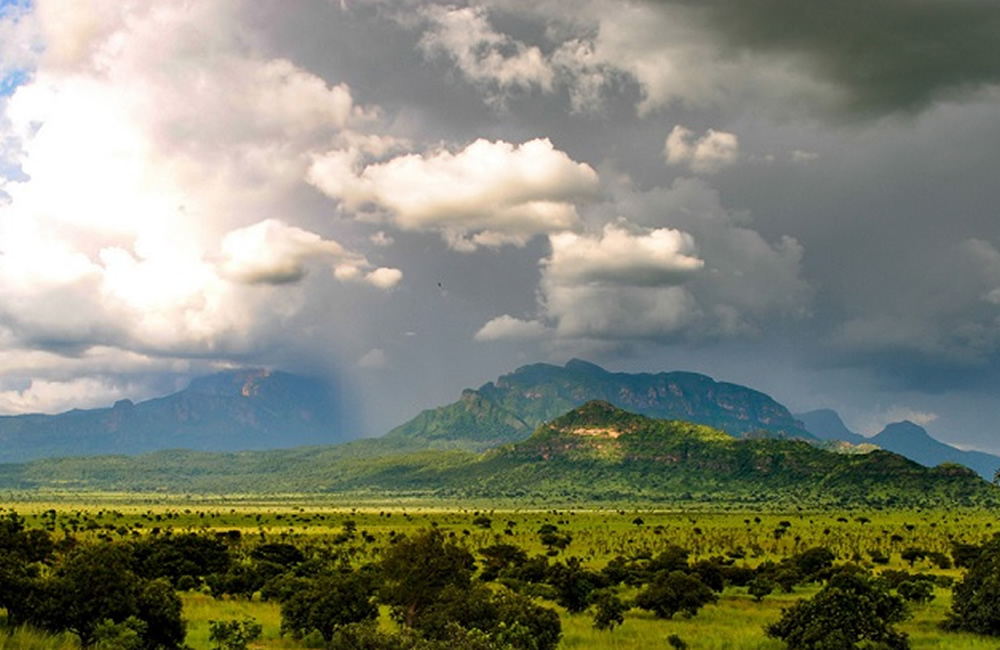


The Uganda Wildlife Authority (UWA) and conservation non-profit, Space for Giants, have entered into a co-management partnership agreement to revive and promote Pian Upe Wildlife Reserve as one of East Africa’s premier game parks. The game reserve found in the north eastern region of Karamoja is the second largest protected area in Uganda.
The new deal which was signed in the eastern city of Soroti on July 15, and is the first-of-its-kind in Uganda, will see UWA retain the wildlife management forte while Space for Giants, a conservation agency that has over the last 20 years partnered with 10 African governments to unlock investments in their countries’ protected areas, is expected to raise money needed to run the wildlife reserve on a day-to-day basis.
John Makombo, UWA’s director of conservation signed on behalf of UWA while Dr Max Graham signed on behalf of Space for Giants under the watchful eyes of the Chief Administrative Officers of Amudat, Bukedea, Bulambuli, Katakwi, Kumi, Kween, Nabilatuk, Nakapiripirit and Napak – the districts that neighbour this game reserve.
Makombo said the agreement is a major step in the sustainable conservation of the reserve. “We hope to get more benefits for the local communities which will strengthen our collaboration with partners to commit to conservation.”
“If everyone plays their part, there will be visible benefits to the communities,” he said. Dr Max Graham, the Founder and CEO, Space for Giants noted that his organisation has over the last seven years collaborated with the government of Uganda in the area of conservation.
He expressed his confidence in the partnership with UWA, the District Local Governments and the Pian Upe Community Wildlife Association.
“Through this co-management partnership, the Ugandan Government sets in motion the process to fully restore Pian Upe as one of East Africa’s premiere Parks,” he said.
Graham said in addition to investing in Pian Upe’s exceptional natural habitat and the conservation of its biodiversity, the co-management agreement also enhances Pian Upe’s value for local communities and its economic contribution to the country.
It is not yet clear how much money is required to resuscitate Pian Upe although a figure of around US$ 8 million (£6.57 million) has been mentioned by senior government officials.
However, a source close to Space for Giants confirmed that the non-profit is yet to work out a detailed budget of how much is needed to run the park.
“Space for Giants has to work out what’s needed first, then raise it, then spend it,” the source said.
Once the money is mobilised, it will be used for securing the wildlife reserve, investing in community enterprises, scaling up law enforcement, fire management, conducting wildlife censuses and ultimately re-introducing key species.
Space for Giants will present a business plan to the initiative’s board within six months setting out in detail its approach and budget.
It is expected the finance will come primarily through selling carbon offsets, under a carbon project that has already been launched and seeks to secure the initial funding required to execute the project. Space for Giants will also seek complementary philanthropic support for the project.
Whenever the decision is made, communities from the neighbouring nine districts in eastern Uganda and wildlife reserves will see significantly improved economic and ecological benefits under this pioneering new conservation investment agreement.
More than 150,000 people live in the area surrounding Pian Upe. Jobs and business opportunities arising from the reserve’s rejuvenation are expected to go to locals first.
George Owoyesigire, the Acting Commissioner in charge of wildlife conservation at the Ministry of Tourism, Wildlife and Antiquities told The Independent on July 29 that Pian Upe’s lowland rangeland nature presents an opportunity for the visitors to see unique attractions.
Established in 1964, the game reserve is renowned for having expanses of distinct wildlands, dominated by plateaus carpeted by both green and golden intact wooded savannah plains. It is also surrounded by mountains.
Although it falls under the second tier of protected areas in the country, Pian Upe Wildlife Reserve is the second largest protected area in Uganda, just behind the more popular Murchison Falls Park. It spans a land area of 2,043 sq km and is described by those who have had the chance to visit it as one of the most picturesque tourist spots in the country.
It is said to host 525 recorded bird species and 163 mammals including Uganda’s widest diversity of plains mammals, including the cheetah, the endangered African wild dog, a rare subspecies of roan antelope, and Rothschild’;s giraffes.
However, local conservationists say Pian Upe’s biodiversity and role in the larger regional ecosystem has over the last few decades been threatened by poaching. For instance, thousands of elephants and rhinos used to roam the reserve, but were lost to poaching.
As a result, the reserve has not been able to generate enough funding to effectively be managed, something which has worsened the threats to its ecosystem resilience, biodiversity and local communities.
The revival of Pian Upe comes at a time when the government has been looking for investors to set up accommodation facilities in Uganda’s so-called tier-2 protected areas (wildlife reserves)—protected areas that have in the past struggled for tourism revenues.
This article is reproduced here as part of the Space for Giants African Conservation Journalism Programme, supported by the major shareholder of ESI Media, which includes independent.co.uk. It aims to expand the reach of conservation and environmental journalism in Africa, and bring more African voices into the international conservation debate. Read the original story here.