

Though primarily known for its mountain gorillas and game parks, Uganda is fast establishing itself as a major destination for faith-based tourism (FBT). This involves the provision of transport, lodging, food and beverages and other related travel and hospitality services for people of faith or these traveling to place of faith.
As a leading safari destination, Uganda has plenty of experience in providing transport and provisions-and it also has an abundance of the based destinations. In fact, FBT is simply a rebranding of something the country’s tourism sector has been doing for decades. Each year on a Martyrs’ Day (3June) more than a million Catholic pilgrims converge on Kampala to affirm their faith and celebrate the survival of Christianity during its darkest hours in Uganda.
Martyrs Day
Martyrs’ Day is a public holiday in Uganda as people mark the occasion in 1886 when 45 young Christians died rather than renounce their faith. With his court polarized between religious functions Muslim, Protestants, Catholics and adherents of traditional religions-Mwanga II king of Buganda tried to extinguish the flame of Christianity. His plan backfired when the martyrs’ deaths caused the flame to burn brighter than before, and more widely.
Although Martyrs’ Day remembers everyone Christians, Jews and Muslims like- who have died in Uganda for their religious belief, the day’s events focus on the Kampala suburb of Namugongo, where 25 of Mwanga’s victim where burned alive. The site of the executions is now occupied alive. The site of the executions is now occupied by a Protestant shrine and Museum.
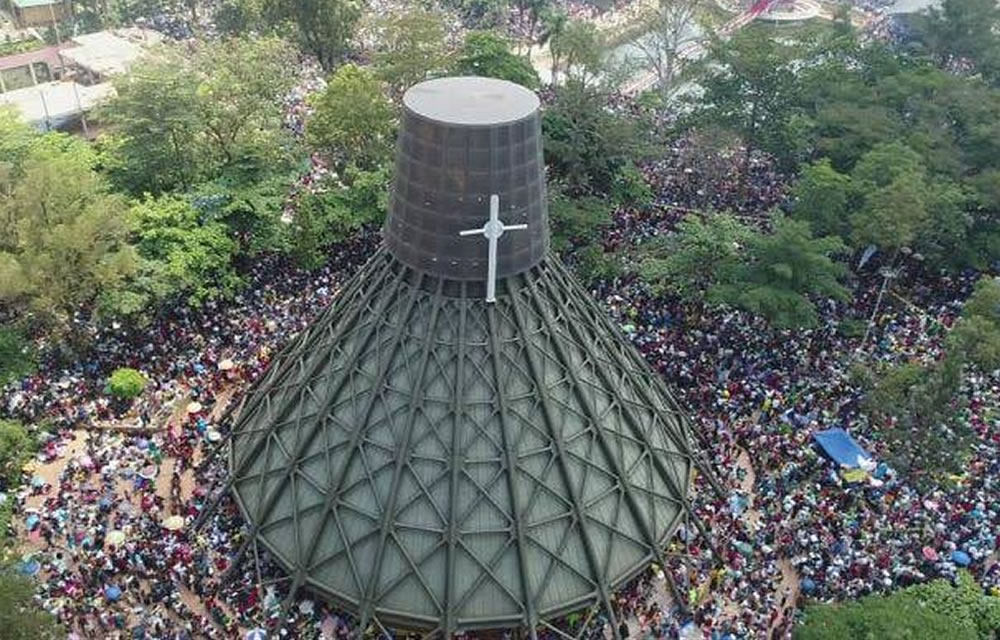
Recently expanded for a visit by Pope Francis in November 2015, the centerpiece is a graphic array of bronze statuary that depicts the diverse methods of torture and execution suffered by the 45 victims. However, the main event of Martyrs’ Day takes place nearby at the Catholic Basilica of the Uganda Martyrs, an imposing metal structure built in 1964 to mark the visit of Pope Pau VI and the canonization of the Catholic martyrs. The anniversary from East Africa but many pilgrims traditionally from all over the world converge on the 25-hectare site to celebrate High mass.
Martyrs’ Day is the highlight of the FBT calendar in Uganda, but tourists can visit Namugongo and other sites of martyrdom at any time by following the recently opened Martyrs’ Trail. Starting at Munyonyo, the site of Mwanga’s palace beside Lake Victoria, where the converts were arrested, and the trail follows the route of their march to Namugongo. An imposing church, built to mark the recent visit of Pope Francis, remembers St Andrew Kaggwa, who was killed at Munyonyo before the march began. Another memorial, in Busega in western Kampala reminds us to that, despite their extraordinary conviction and courage, the martyrs were often teenagers or even children. Joseph Lugalama, for example was 12 years old when he was speared and thrown into the swamp, while his companions were 16 and 17. Further afield, beyond the source of the Nile at Jinja, a covered shrine shelter the rock on which James Hannington, the first Anglican Bishop of East Africa, was murdered in 1885, again on Mwanga’s orders, as he journeyed inland to visit his Bugandan parish.
Pivotal Figures
Not all FBT sites in Uganda involves martyrdom. In the graveyard outside Kampala’s Namirembe Cathedral, tourists can pay their respects to a number of pivotal figures including George Pilkington, who translated the Bible into the Local language; Alexander Mackay, who built the first Church; Sir Albert Ruskin Cook, the missionary doctor who built the county’s first hospital; and Ham Mukasa, who narrowly escaped martyrdom in 1886 and lived to serve the government of Buganda for many years.
Visitors of all faiths are welcome to visit the imposing Old Kampala Mosque, at the foot of Namirembe Hill, said to be the largest in Sub-Saharan Africa. It was initiated by Idi Amin in the 1970s and finally completed with funding from Muammar Gaddafi in 2006.
A focus for Jewish Visitors is Nabugoya Hill, near Mbale, in eastern Uganda, home of the Abaduyaya community, which has been observing Jewish customs and rituals since the 1920s.